
What is a Santoku knife and why do so many home cooks prefer it to a chef’s knife?
If you’re thinking about updating your kitchen knives, you’ve probably come across this name more than once: Santoku. It’s the on‑trend knife that everyone’s talking about – from professional chefs to home cooks – and, of course, they all keep one in their kitchen, recommend it, and, best of all, use it almost every day. But what is it about this Japanese knife that has won over so many food lovers?
Well, it’s time to explain why the Santoku knife is much more than a passing fad – it’s a small revolution for your kitchen. We’ll walk you through how it differs from the classic chef’s knife you’ve always known and why it feels so comfortable and natural to use when you’re cooking at home.
What is a Santoku knife and where does it really come from?
To trace the history of the Japanese Santoku knife, we have to go back to Japan in the mid‑20th century. It emerged as a modern response to the new needs of everyday home cooking. Its name literally means “three virtues” or “three uses”, referring to its impressive ability to handle the three main food groups: meat, fish and vegetables with ease.
It was created with a clear purpose: to be an all‑round, do‑it‑all knife for your home kitchen, not just a tool specialised in a single task, but one designed to make everyday cooking simpler and more efficient. While the classic Western chef’s knife has its roots in professional kitchens, the Santoku was born to make home cooking more practical, comfortable and precise.
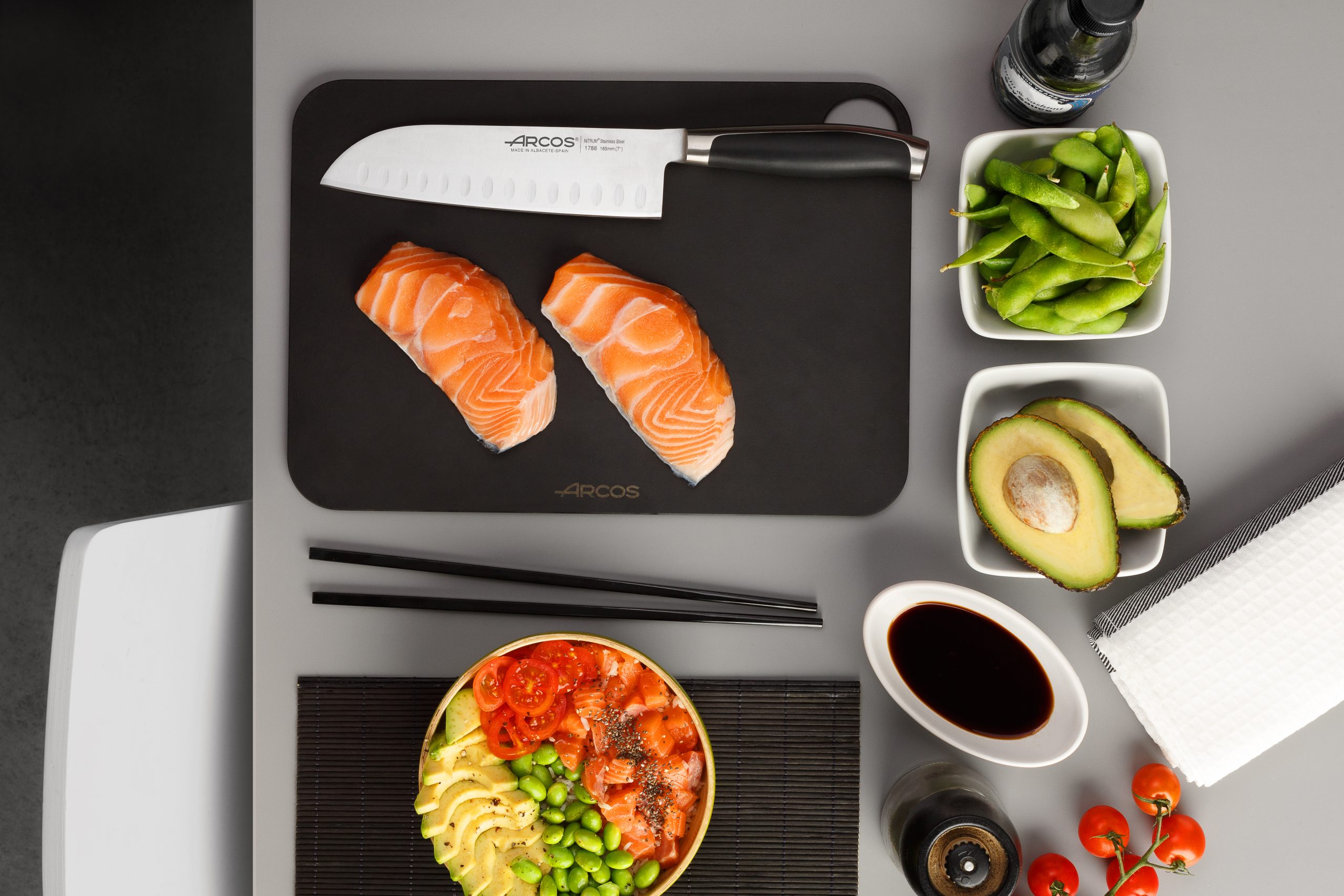
Key features of the Santoku knife
When you look at the key features of a Santoku knife, it becomes clear why it feels so intuitive to use, even for people with little or no experience in the kitchen. Let’s dive in.
This knife has a noticeably shorter blade, usually around 16–18 cm, compared to the typical 20–24 cm of a classic chef’s knife. That makes it much easier to handle, simpler to control and far less intimidating for home cooks who aren’t professional chefs.
The Santoku also has a slightly taller blade than many European knives, which gives your knuckles better clearance, improves stability on the board and makes it easier to scoop up and transfer your chopped ingredients. All wins.
If you look closely, you’ll see the tip is often more rounded or has a gentle downward slope. This encourages straight, precise cuts and helps reduce that feeling of the knife being “too dangerous” in your hand.
In terms of cutting style, it’s quite different from a chef’s knife, which is usually used with a rocking motion. The Santoku works best with straight, push or pull cuts, which tend to feel more natural when slicing vegetables, trimming meat or cutting fish.
Why so many home cooks prefer a Santoku
The key is that the Santoku is a knife designed for real everyday home use. As we mentioned, it’s much easier to control. Because it’s shorter and well balanced, it feels more manageable. For anyone who isn’t used to working in a professional kitchen, that means greater safety, less hand fatigue and more precise cuts with hardly any effort.
On top of that, it fully lives up to the “three virtues” behind its name. You can use it to chop vegetables, fillet fish, slice boneless meat, prepare fruit and cut up most of the everyday ingredients you cook with. In the end, it’s very likely you’ll end up reaching for it instead of your old chef’s knife for most tasks.
At home, we don’t usually deal with huge cuts of meat or industrial‑style prep, so the Santoku fits much better with your kitchen’s rhythm. It’s ideal for smaller portions, standard‑size chopping boards and the recipes you cook on a daily basis.
Santoku vs chef’s knife: which one should you choose?
It’s a bit of a trick question, because it’s not really about choosing one over the other, but about which knife fits your cooking style best. If you often prepare large quantities of food at home, we’d suggest a chef’s knife – its longer blade will probably feel more comfortable for you. But if that’s not the case, go for a Santoku: it’s more compact, more precise and more comfortable to use. You really will notice the difference.
Now that you know what a Santoku knife is, where it comes from and what its advantages are, the next step is to start using it and pairing it with other models in your Japanese knife collection. Remember, the Santoku isn’t just a trendy knife – it’s a genuinely practical solution for your everyday cooking.
Tal vez también te interese:
The 5 Kitchen Knives You Actually Need (and How to Choose Them)
One for meat, another for fish, a special one for cheese, even one just for bread. We completely understand— before you know it, one of your kitchen drawers ends up overflowing with all kinds of knives. But if we’re honest with ourselves, how many of them do we actually use on a regular basis? We all already know the answer.
Which Foods Are Most Corrosive for Knife Steel?
Today we want to share something that many cooking enthusiasts discover far too late: knives are not only damaged by poor maintenance, impacts, or improper sharpening. There are also certain everyday foods that can directly affect the condition of the blade and gradually speed up its wear without us even noticing.
Ceramic non-stick frying pan: how non-stick coatings have evolved and what you should look for before buying
In current collections such as the Samoa professional series, the main focus is for these pans to combine good heat distribution, a modern non-stick coating, and ease and comfort in handling.