
The 5 most common mistakes people make when using a Santoku knife at home (and how to avoid them)
Cooking enthusiasts like you and us simply can’t live without a Santoku knife in the kitchen. And it’s no coincidence that this Japanese knife has become such a favourite — it’s thanks to its versatility, precision, and how effortlessly it handles. Even those who aren’t exactly kitchen pros love using it! But because of that, many people don’t actually know how to get the best out of it — a real shame.
That’s where we come in. We’ll clear up your doubts about how to use a Santoku knife properly so you can cook better, cut cleaner, and avoid any kitchen disasters. Let’s get to the point — it’s time to discover the 5 most common mistakes beginners make and how you can easily avoid them.
Not placing the blade correctly when cutting
One of the most common mistakes when using a Santoku knife is trying to cut only with the tip or making a sharp, vertical motion. That’s not what this knife is designed for.
The Santoku has a wide, slightly curved blade made to give you a stable, controlled cut by keeping most of the edge in contact with the board. If you don’t do this, you’ll lose precision, your cuts will be uneven, and you’ll be more likely to have the knife slip.
Using it to cut bones or very hard foods
Another classic. A Santoku isn’t meant to cut everything; it’s really designed for vegetables, fruit, boneless meats and fish — anything that needs a fine, precise cut. If you use it on the wrong type of food, you’ll most likely chip the edge or even damage the blade.
So remember: when it comes to bones, reach for a knife that’s made for the job.
Using the wrong chopping board
It might seem like a small detail, but your chopping board has a big impact on the life of your knife. If you cut directly on worktops, plates, glass boards or other hard surfaces, you’ll wear down the edge much faster and increase the risk of the knife slipping.
Our advice is to use a wooden board or a food-safe fibre board. They absorb the impact far better, protect the edge of your knife and help keep your cuts much more stable.
Washing your Santoku in the dishwasher
It’s far more common than you might think – and often done without even realising it. The dishwasher combines moisture, heat, harsh detergents and knocks against other utensils, which is pretty much the perfect recipe for ruining your knife.
Putting it in the dishwasher will only lead to a dull edge, corrosion on the steel, damage to the handle and loosened joints.
Our recommendation is to always wash it by hand in warm water with a mild soap, dry it almost straight away and store it somewhere it’s properly protected. Do that, and its lifespan will increase dramatically.
Not keeping the edge sharp regularly
Yes, a well-sharpened Santoku is actually much safer than a dull one — even if it sounds a bit contradictory. When the blade starts to lose its edge, you have to use more force, which increases the risk of slipping and makes your cuts far less clean.
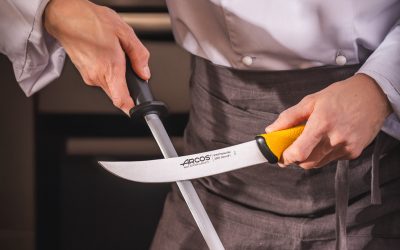
Refresh the edge regularly with a honing steel to keep it in top condition.
Elige un buen Santoku y evita sustos en tu cocina
On top of your technique and following our tips to the letter, the knife itself makes a big difference. A well-balanced Santoku with a comfortable grip and long-lasting edge will make cutting much easier and help you avoid common handling mistakes.
If you’re thinking about adding one to your kitchen, at Arcos we offer a wide range of high-quality Japanese knives. They’re designed to feel intuitive from the very first use: well-balanced in the hand, with an ergonomic handle and a blade made for highly precise cuts. Any of these models, known for their comfort and ease of use, deserves a place in your home kitchen.
All in all, a Santoku is a very versatile knife, but like any tool it needs to be used properly. From chopping vegetables to slicing boneless meats and fish with precision, if you avoid these five basic mistakes and build good habits, you’ll have a knife that will serve you well for many years. A good Santoku doesn’t just cut better – it makes cooking more comfortable, safer and genuinely more enjoyable.
Tal vez también te interese:
Arcos Non-Toxic: Our Guide to Toxin-Free Cookin
We are becoming increasingly conscious of our diet. We read food labels over and over, look for higher-quality ingredients, opt for organic products, and try to maintain a balanced diet. However, there is still one aspect of our cooking that we often overlook: choosing the right cooking utensils.
Types of knife holders for different kitchens
Durante años, los cuchillos han estado siempre fuera del alcance de cualquiera que pasará por nuestra cocina. Es más, solo los veíamos justo cuando nos tocaba utilizarlos. Pero esto está cambiando por completo, solo hay que echar una simple vista en las cocinas modernas para ver que hoy ya están completamente integradas en su diseño, ocupando incluso un lugar protagonista en nuestras encimeras.
Types of honing steels: when and how to use the one you need
At some point in a knife’s lifespan, it stops cutting as well as it did when it was first used.